
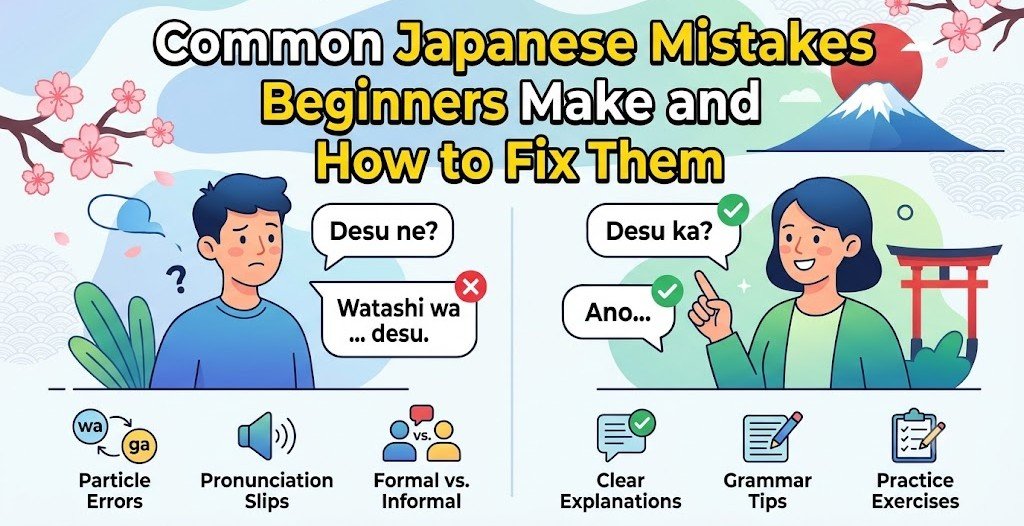
Every Japanese learner makes mistakes early on. That is completely normal.
What matters is catching those mistakes before they become habits. Many beginners repeat the same errors for months without realising, which slows down their progress and makes it harder to correct later.
This guide covers the most common Japanese mistakes that beginners make, explains why they happen, and shows you the correct version with simple examples you can use right away.
Common Japanese Grammar Mistakes Beginners Make
Japanese grammar has a few patterns that confuse almost every beginner, especially learners whose first language is English.
Confusing は (wa) and が (ga)
This is the most common grammar mistake in early Japanese study.
The mistake: Using が (ga) when は (wa) is correct, or avoiding が (ga) entirely because は (wa) feels safer.
|
Particle |
Role |
When to Use |
|---|---|---|
|
は (wa) |
Topic marker |
Talking about yourself in general, making statements, self-introductions |
|
が (ga) |
Subject marker |
Introducing new information, specific events, emphasis |
Example:
|
Version |
Japanese |
Romaji |
Meaning |
|---|---|---|---|
|
Incorrect |
私が学生です |
Watashi ga gakusei desu |
(unnatural for a simple introduction) |
|
Correct |
私は学生です |
Watashi wa gakusei desu |
I am a student |
|
Correct (with が) |
猫がいます |
Neko ga imasu |
There is a cat (new information) |
Why it happens: English has only one subject structure, so the distinction between "topic" and "subject" does not feel natural at first.
Fix: For self-introductions and general statements, use は (wa). When pointing out something new or specific, use が (ga).
Mixing Up に (ni) and で (de)
Both particles relate to location, which is why beginners often use them interchangeably. They are not interchangeable.
|
Particle |
Role |
Example |
|---|---|---|
|
に (ni) |
Direction or destination, location of existence |
学校に行きます (Gakkou ni ikimasu) - Going to school |
|
で (de) |
Location where an action happens, means or method |
図書館で勉強します (Toshokan de benkyou shimasu) - Studying at the library |
Example of the mistake:
|
Version |
Japanese |
Romaji |
Note |
|---|---|---|---|
|
Incorrect |
図書館に勉強します |
Toshokan ni benkyou shimasu |
に is wrong here because studying is an action happening at a location |
|
Correct |
図書館で勉強します |
Toshokan de benkyou shimasu |
で marks where the action takes place |
Fix: Ask yourself: is the location where something exists (に), or where something is done (で)?
Using English Word Order in Japanese Sentences
English follows Subject + Verb + Object order. Japanese follows Subject + Object + Verb.
Beginners often construct sentences in English order and simply swap in Japanese words, which produces unnatural or grammatically wrong sentences.
Example:
|
Version |
Japanese |
Romaji |
|---|---|---|
|
Incorrect |
私は食べますピザ |
Watashi wa tabemasu piza |
|
Correct |
私はピザを食べます |
Watashi wa piza wo tabemasu |
Fix: Always place the verb at the end. Build the habit by writing short sentences in the correct order every day before progressing to longer ones.
Japanese Pronunciation Mistakes to Watch Out For
Long Vowels and Double Consonants
Japanese has short and long vowels, and the difference in pronunciation changes the meaning completely.
|
Word |
Hiragana |
Romaji |
Meaning |
|---|---|---|---|
|
おじさん |
おじさん |
ojisan |
Uncle |
|
おじいさん |
おじいさん |
ojiisan |
Grandfather |
|
きて |
きて |
kite |
Please come |
|
きって |
きって |
kitte |
Stamp |
For double consonants (such as きって), make a brief pause before the doubled consonant. Skipping that pause makes the word sound like a different word entirely.
Fix: Practise long vowels and geminate consonants separately. Listen to native speakers and repeat slowly until the timing feels natural.
Japanese Rhythm and Sound Patterns
English is a stress-timed language where some syllables are emphasised more than others. Japanese is mora-timed: every mora (sound unit) gets roughly equal time.
Beginners often stress syllables the way they would in English, which sounds unnatural to Japanese speakers.
Fix: Listen to Japanese audio daily. NHK Web Easy and Japanese podcasts for beginners are good starting points. Shadowing (repeating aloud after a native speaker) builds natural rhythm faster than text study alone.
Mistakes Beginners Make When Learning Japanese Writing
Relying Too Much on Romaji
Romaji is a romanized version of Japanese sounds used in some beginner textbooks. It is useful for the first few days, but staying on romaji for weeks or months is one of the most common learning mistakes.
Romaji creates a reading habit that is incompatible with real Japanese text. Menus, signs, apps, and Japanese content use Hiragana, Katakana, and Kanji. Learners who rely on romaji consistently struggle to progress beyond beginner level.
Fix: Commit to learning Hiragana and Katakana in the first two to three weeks. Both scripts have 46 characters each and can be memorised with daily practice using flashcards or writing repetition.
Trying to Memorise Kanji Without Context
Many beginners study Kanji as standalone characters: learning the character and its meaning without learning the vocabulary words that use it.
This approach does not work well in the long run. Kanji are most effectively remembered when they are attached to real words you use and hear regularly.
Fix: Learn Kanji through vocabulary. For example, learn 山 (yama, mountain) through the word 富士山 (Fujisan, Mount Fuji) rather than in isolation. The How to Memorize Japanese Kanji Faster guide covers practical techniques including radicals, mnemonics, and spaced repetition.
Speaking Mistakes That Hold Beginners Back
Using Casual Language in Formal Situations
Japanese has two main registers: casual (plain form) and polite (masu/desu form). Beginners who learn from anime or casual content often use casual Japanese in formal or professional settings, which can come across as rude.
|
Situation |
Casual |
Polite |
|---|---|---|
|
Thank you |
ありがとう (arigatou) |
ありがとうございます (arigatou gozaimasu) |
|
Eat |
食べる (taberu) |
食べます (tabemasu) |
|
I am |
だ (da) |
です (desu) |
Fix: Begin with polite form (masu/desu). This is appropriate for most real-life situations and is what structured courses teach from the start.
Word-for-Word Translation From English
Direct translations from English produce unnatural Japanese. Many English expressions do not have a direct Japanese equivalent and must be expressed differently.
Example:
|
English |
Literal Translation |
Natural Japanese |
|---|---|---|
|
I am hungry |
私は空腹です (Watashi wa kuufuku desu) |
お腹が空きました (Onaka ga sukimashita) |
|
Nice to meet you |
(no direct literal equivalent) |
はじめまして (Hajimemashite) |
Fix: Learn common expressions as complete phrases rather than word-by-word translations. A set of 50 to 100 natural Japanese expressions covers most beginner conversational needs.
Being Afraid to Speak Because of Mistakes
Many beginners avoid speaking because they are not confident. But speaking regularly, even imperfectly, is what builds confidence and accuracy over time.
Native Japanese speakers and teachers respond positively to learners who try. Waiting until your Japanese is "good enough" to start speaking means waiting indefinitely.
Fix: Speak from day one, even if it is just greetings and simple sentences. A structured Japanese course with speaking practice gives you a safe environment to practise without fear of judgment.
Simple Steps to Avoid These Common Mistakes
-
Study grammar through examples, not just rules. Write your own sentences using each new pattern.
-
Listen to native Japanese audio daily for at least 10 to 15 minutes. Pronunciation and rhythm improve through repeated listening.
-
Drop romaji as early as possible. Move to Hiragana and Katakana within your first month.
-
Use the polite form (masu/desu) consistently until you are confident in when casual form is appropriate.
-
Speak aloud during every study session, even if it is just repeating example sentences from your textbook.
Quick Practice Quiz
Check your understanding of the key points in this guide.
Question 1: Which particle completes this self-introduction correctly?
私___ 学生です (Watashi ___ gakusei desu)
-
A: が (ga)
-
B: は (wa) ✓
Question 2: Which particle is correct for an action happening at a location?
公園___遊びます (Kouen ___ asobimasu) — Playing at the park
-
A: に (ni)
-
B: で (de) ✓
Question 3: Which sentence has correct Japanese word order?
-
A: 私はピザを食べます (Watashi wa piza wo tabemasu) ✓
-
B: 私は食べますピザ (Watashi wa tabemasu piza)
Question 4: Which is the polite way to say "thank you"?
-
A: ありがとう (arigatou)
-
B: ありがとうございます (arigatou gozaimasu) ✓
Question 5: Which word means "grandfather"?
-
A: おじさん (ojisan)
-
B: おじいさん (ojiisan) ✓
Score: 4 to 5 correct: Excellent, you have a solid grasp of the basics. 2 to 3 correct: Review the sections that tripped you up. 0 to 1 correct: Go back through the grammar and pronunciation sections before your next study session.
Correcting these mistakes early makes every stage of Japanese learning easier. If you want structured guidance, expert feedback, and a clear study plan from N5 through N1, NihongoMax offers Japanese language courses and JLPT preparation programs online and offline in Delhi.
Explore Japanese language courses and build the right foundations from your very first lesson.
Wrapping Up
The mistakes covered in this guide are not signs of failure. They are the predictable patterns that almost every beginner encounters when learning Japanese.
Catching them early, understanding why they happen, and practising the correct version consistently is what separates learners who progress smoothly from those who plateau. Use the examples, comparison tables, and quiz in this guide as a regular reference during your early months of Japanese study.
When you are ready for structured learning with guided practice and real feedback, visit Learn japanese in delhi to explore beginner Japanese courses designed around the way Japanese is actually used.
FAQs
What mistakes do beginners make when speaking Japanese?
The most common speaking mistakes include using casual language in formal situations, translating English phrases directly into Japanese, and placing the verb in the wrong position.
Beginners also frequently mispronounce long vowels and double consonants, which changes the meaning of words. Avoiding romaji early and practising with native audio helps correct pronunciation habits before they become fixed.
Is Japanese grammar difficult for English speakers?
Japanese grammar is structured differently from English, but individual rules are not necessarily harder.
The main adjustment for English speakers is word order (verb at the end), the particle system (は, が, に, で, を, etc.), and the distinction between polite and casual speech. These feel unfamiliar at first but become intuitive with consistent daily practice and example-based study.
Should I learn Hiragana before Kanji?
Yes, Hiragana (and Katakana) should always come before Kanji.
Hiragana is the foundational phonetic script of Japanese. It appears in every Japanese text and is used to read and write all Japanese sounds. Kanji cannot be studied meaningfully without Hiragana knowledge because Kanji readings are written in Hiragana. Most learners complete Hiragana and Katakana within two to three weeks of dedicated practice.
How can I improve my Japanese pronunciation?
Listen to native Japanese audio daily and practise repeating (shadowing) what you hear.
Pay specific attention to long vowels (holding the sound for two beats) and double consonants (pausing briefly before the repeated consonant). NHK Web Easy, beginner Japanese podcasts, and course listening exercises are all good resources. Avoid relying on romaji pronunciation guides for more than your first week of study.
How long does it take to speak basic Japanese?
Most learners with consistent daily study can hold simple conversations in Japanese within 3 to 6 months.
Reaching JLPT N5 level (basic vocabulary and grammar) takes approximately 3 to 4 months of structured daily study. Speaking ability develops faster when learners practise speaking from the start rather than waiting until they feel "ready." A structured course environment provides early speaking practice with corrective feedback.