
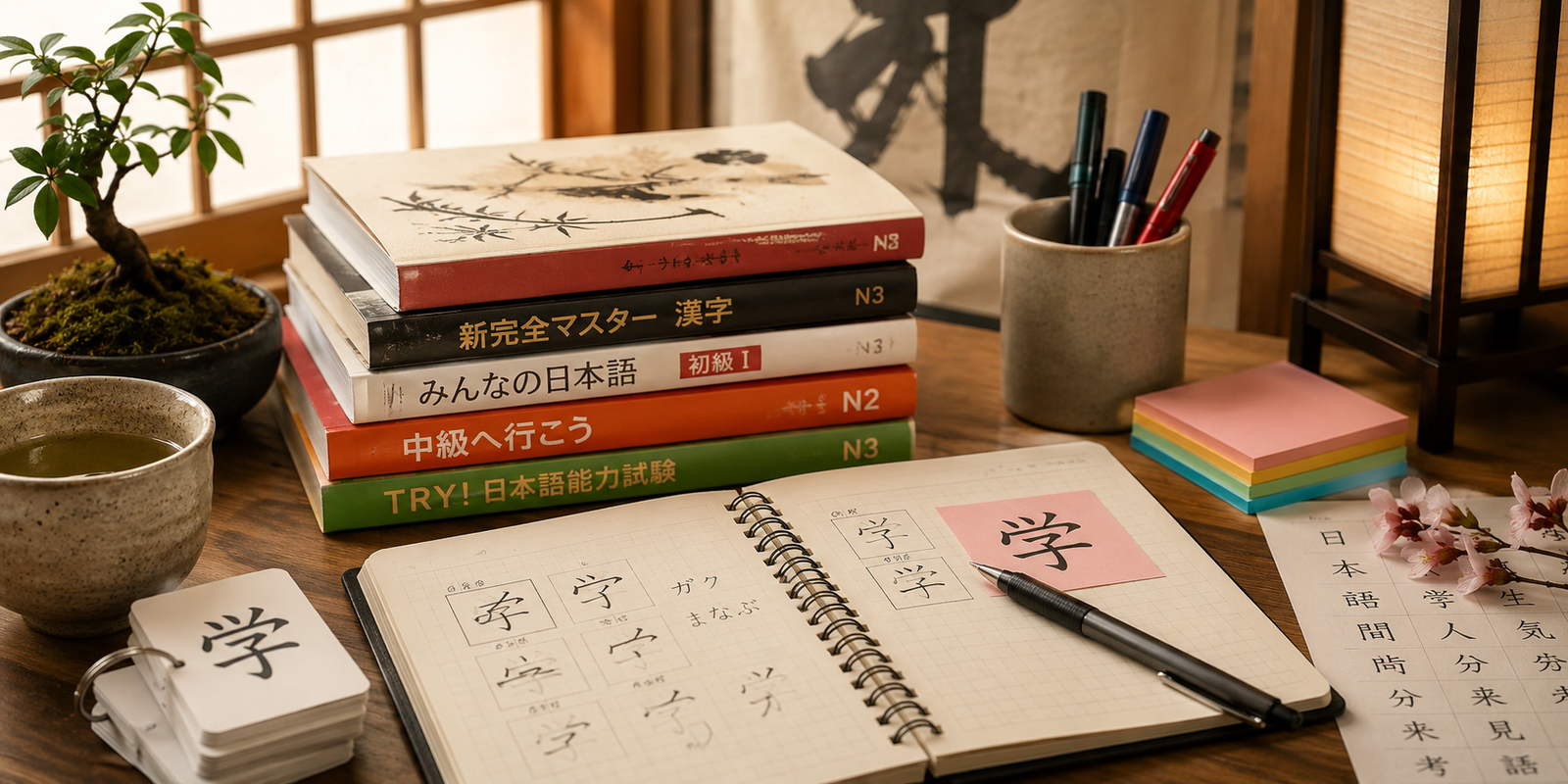
Kanji is one of the first walls every Japanese learner hits.There are over 2,000 Joyo (standard use) Kanji in Japanese. For English and Hindi speakers with no exposure to Chinese characters, this can feel like an impossible mountain.
But here is what most beginners get wrong: they try to memorize Kanji by rote repetition alone. Writing the same character 50 times without understanding it is slow, frustrating, and quickly forgotten.
The learners who progress fastest use a combination of visual techniques, vocabulary context, and consistent daily review.
This guide breaks down 7 proven Japanese Kanji memorization techniques, with real examples, a 7-day study plan, and a level-by-level target to keep you on track.
Why Kanji Is Challenging and Why Memorization Alone Does Not Work
Kanji presents three challenges at once: shape, meaning, and reading. Each Kanji has at least one meaning and usually two types of readings: the Chinese-origin reading (音読み, onyomi) and the native Japanese reading (訓読み, kunyomi). One character can have multiple readings depending on context.
Trying to memorize all three elements for hundreds of characters using repetition alone overloads your working memory.
The solution is not to study harder. It is to study smarter, using techniques that give each Kanji a hook in your memory.
Understand Kanji Before You Try to Memorize It
Learn Radicals First
Kanji are not random shapes. They are built from smaller components called radicals (部首, bushu).
Learning common radicals first gives you a visual shortcut to understanding unfamiliar Kanji. When you see 明 (bright/clear), you recognise it as 日 (sun) + 月 (moon), two familiar radicals combined. There are around 214 official radicals in Japanese. Learning the 50 to 80 most common ones significantly reduces the time needed to learn new Kanji.
Learn the Readings Alongside the Meaning
Never learn a Kanji shape without its reading. Start with the most commonly used reading for each character. The onyomi reading is often more useful in compound words (jukugo), while the kunyomi reading appears in standalone words.
For example: 山 (mountain)
● Kunyomi: やま (yama) — used in words like 山道 (yamazichi, mountain path)
● Onyomi: さん (san) — used in words like 富士山 (Fujisan, Mount Fuji)
Always Connect Kanji to Vocabulary
Do not study Kanji in isolation. Always attach each character to at least one real word. Seeing a Kanji inside a vocabulary word you actually use makes the memory stick far more effectively than studying the character alone.
7 Effective Ways to Memorize Japanese Kanji Faster
1. Use Visual Mnemonics
Create a short visual story or image that connects the Kanji's shape to its meaning. Example: 山 (mountain) looks like three mountain peaks. Picture a mountain range. Every time you see this character, the image of peaks comes to mind instantly.
2. Learn Radicals First
Break unfamiliar Kanji into their radical components and learn those building blocks first. Example: 森 (forest) = 木 + 木 + 木 (three trees). Once you know 木 (tree), 森 is immediately logical.
3. Use Spaced Repetition
Spaced repetition is a review system that shows you Kanji again just before you are about to forget them. Flashcard apps like Anki use this system automatically. It takes 5 to 10 minutes a day and is one of the most evidence-supported methods for long-term retention.
4. Learn Kanji Through Words and Sentences
Always learn Kanji inside real vocabulary and sentences, not as isolated characters. Example: Learn 食 (eat/food) through words like 食べる (taberu, to eat) and 食堂 (shokudo, cafeteria). The word gives the character meaning and context that sticks.
5. Practice Writing Regularly
Writing activates a different type of memory than reading. Write each new Kanji five times while saying the meaning and reading aloud. This multi-sensory approach, combining visual, motor, and auditory memory, speeds up retention.
6. Group Similar Kanji Together
Some Kanji share radicals, shapes, or meanings. Studying them as a group helps you learn distinctions and patterns at the same time. Example: 大 (big), 太 (fat, thick), 犬 (dog) — these look similar but have clear differences. Studying them together makes each one easier to remember than learning them separately.
7. Review Difficult Kanji More Frequently
Track the Kanji you consistently get wrong. Spend more time reviewing those specific characters until they become automatic.
Most learners advance too quickly, adding new Kanji before older ones are solid. A strong foundation in 50 Kanji is more useful than a shaky familiarity with 200.
Kanji in Action: Examples Using Radicals, Mnemonics, and Vocabulary
Here are 10 beginner Kanji with their radicals, a mnemonic, and a vocabulary example to demonstrate how these techniques work in practice:
|
Kanji |
Meaning |
Radical Hint |
Mnemonic |
Vocabulary Example |
|
山 |
Mountain |
Self |
Looks like three mountain peaks |
山道 (yamazichi) mountain path |
|
日 |
Sun / Day |
Self |
A box with a line, like the sun |
今日 (kyou) today |
|
木 |
Tree |
Self |
Trunk with roots and branches |
木曜日 (mokuyoubi) Thursday |
|
人 |
Person |
Self |
A person walking, two legs |
人口 (jinkou) population |
|
口 |
Mouth |
Self |
An open square, like an open mouth |
人口 (jinkou) population |
|
火 |
Fire |
Self |
Flames rising upward |
火曜日 (kayoubi) Tuesday |
|
水 |
Water |
Self |
Flowing water, rippling lines |
水曜日 (suiyoubi) Wednesday |
|
森 |
Forest |
木 x3 |
Three trees make a forest |
森林 (shinrin) forest |
|
明 |
Bright / Clear |
日 + 月 |
Sun and moon together mean bright |
明日 (ashita) tomorrow |
|
休 |
Rest |
人 + 木 |
A person leaning against a tree to rest |
休日 (kyuujitsu) holiday |
Notice how every mnemonic uses the visual shape of the Kanji. This approach, connecting the look of the character to its meaning, is far faster than pure repetition.
For more foundational vocabulary to pair with your Kanji study, explore the top Japanese words and phrases for beginners as a complementary resource.
How Many Kanji Do You Need? A Level-by-Level Guide
Here is a realistic Kanji target for JLPT preparation:
|
JLPT Level |
Total Kanji Required |
New Kanji at This Level |
Approximate Study Time |
|
N5 |
~100 |
100 |
1 to 2 months |
|
N4 |
~300 |
~200 new |
2 to 3 months |
|
N3 |
~650 |
~350 new |
3 to 5 months |
|
N2 |
~1,000 |
~350 new |
6 to 10 months |
|
N1 |
~2,000 |
~1,000 new |
10 to 18 months |
Note: These are approximate targets. Actual requirements depend on your reading and vocabulary integration, not just isolated character count.
For a structured JLPT preparation approach that integrates Kanji study alongside grammar, vocabulary, and listening, read our guide on how to prepare for JLPT.
Build a Daily Kanji Study Routine That Sticks
Set a realistic daily target and protect that study time every day. For most learners, 5 to 7 new Kanji per day is a sustainable and effective pace. Learning more than 10 new characters daily without sufficient review often leads to rapid forgetting.
The most important rule: spend more time reviewing than learning new Kanji. A common mistake is racing forward to new characters while older ones slip away. For every new Kanji session, spend at least equal time reviewing characters from the previous week.
Sample 7-Day Kanji Study Plan
(Suitable for N5 to N4 learners, approximately 30 to 45 minutes per day)
|
Day |
New Kanji |
Review |
Activity |
|
Day 1 |
5 new Kanji (nature: 山, 川, 木, 火, 水) |
None |
Learn shape, meaning, reading, vocabulary example for each |
|
Day 2 |
5 new Kanji (time: 日, 月, 年, 時, 分) |
Day 1 Kanji |
Review Day 1 using flashcards; learn Day 2 with mnemonics |
|
Day 3 |
5 new Kanji (people: 人, 女, 男, 子, 父) |
Day 1 + Day 2 |
Writing practice for Day 1; flashcard review for Day 2 |
|
Day 4 |
5 new Kanji (verbs: 食, 飲, 見, 行, 来) |
Day 1 to Day 3 |
Write vocabulary sentences using earlier Kanji |
|
Day 5 |
5 new Kanji (adjectives: 大, 小, 高, 長, 新) |
Day 2 to Day 4 |
Spaced repetition review; focus on ones you missed |
|
Day 6 |
No new Kanji |
All 25 Kanji from Day 1 to Day 5 |
Full review using flashcards, identify weak characters |
|
Day 7 |
No new Kanji |
Weak characters from Day 6 |
Targeted review; write each weak Kanji in a sentence |
Repeat this cycle weekly, adding a new set of 25 Kanji each week while maintaining rolling review of earlier characters.
Common Kanji Learning Mistakes to Avoid
● Memorizing too many at once: Learning 50 Kanji in a day and forgetting 45 of them is worse than learning 5 and retaining all of them. Set a sustainable daily target.
● Ignoring readings: A Kanji you can recognise but not read or pronounce is half-learned. Always pair the shape with its reading from the start.
● Learning Kanji without vocabulary: A character without a word attached to it has no practical use. Every new Kanji needs at least one vocabulary example.
● Skipping regular review: New Kanji fade quickly without reinforcement. Build review into every study session, not just when you feel you are forgetting.
● Focusing only on writing: Writing alone, without reading and recognition practice, slows your overall progress. Balance all four skills: recognising, reading, writing, and using in context.
Best Tools and Resources for Learning Kanji
● Anki: Free flashcard app with spaced repetition. Use pre-made JLPT Kanji decks or build your own.
● WaniKani: A structured online platform that teaches Kanji through radicals and mnemonics in a set order.
● Jisho.org: Free Japanese dictionary with radical search, example sentences, and stroke order diagrams.
● JLPT preparation books: The Nihongo So-Matome and Shin Kanzen Master series include dedicated Kanji workbooks for each JLPT level.
● Kanji worksheets: Printed stroke order practice sheets help reinforce writing memory.
● Japanese language classes: A structured course integrates Kanji study with grammar, vocabulary, and reading practice in a way that self-study alone rarely achieves.
Joining a structured Japanese course in Delhi gives you a clear Kanji curriculum aligned with your JLPT level, teacher feedback on writing, and regular practice tests. Explore the Japanese language course in Delhi at NihongoMax and find a batch that fits your schedule.
Wrapping Up
Learning Kanji is a long-term process, but it does not have to be overwhelming. The learners who make the fastest progress are not the ones who study the most hours. They are the ones who use the right techniques consistently: mnemonics, radicals, vocabulary context, spaced repetition, and daily review.
Start with 5 to 7 new Kanji per day. Review every day. Build vocabulary alongside characters. And give yourself time.
If you want structured Kanji and JLPT preparation with qualified teachers, visit NihongoMax to explore Japanese language courses in Delhi available online and offline at all levels.
FAQs
How long does it take to learn 100 Kanji?
At a pace of 5 to 7 new Kanji per day with consistent review, you can learn 100 Kanji in approximately 3 to 4 weeks. However, "learning" means being able to read, write, and use each character in vocabulary. Rushing through 100 Kanji in a week without review rarely leads to actual retention. A steady pace with daily review is always more effective.
Should I learn Kanji or Hiragana first?
Always learn Hiragana and Katakana before starting Kanji. Hiragana and Katakana are phonetic scripts and are the foundation of reading Japanese. Most beginner resources are written in Hiragana with Kanji introduced gradually. Trying to learn Kanji before mastering Hiragana makes the process significantly harder than it needs to be.
Is writing Kanji necessary for memorization?
Writing helps but is not strictly necessary for every learner. Writing activates motor memory and helps many learners retain Kanji faster. However, if your primary goal is reading comprehension and JLPT preparation, recognition practice (flashcards and reading) can be sufficient at lower levels. For N2 and N1, writing ability becomes more practically useful.
What is the best app for learning Kanji?
Anki is the most widely recommended free tool due to its spaced repetition system and customisable decks. Pre-made JLPT Kanji decks are available for N5 through N1. WaniKani is a more structured paid option that teaches Kanji in a specific order using radical-based mnemonics. Both tools work well when used consistently alongside a structured course or textbook.