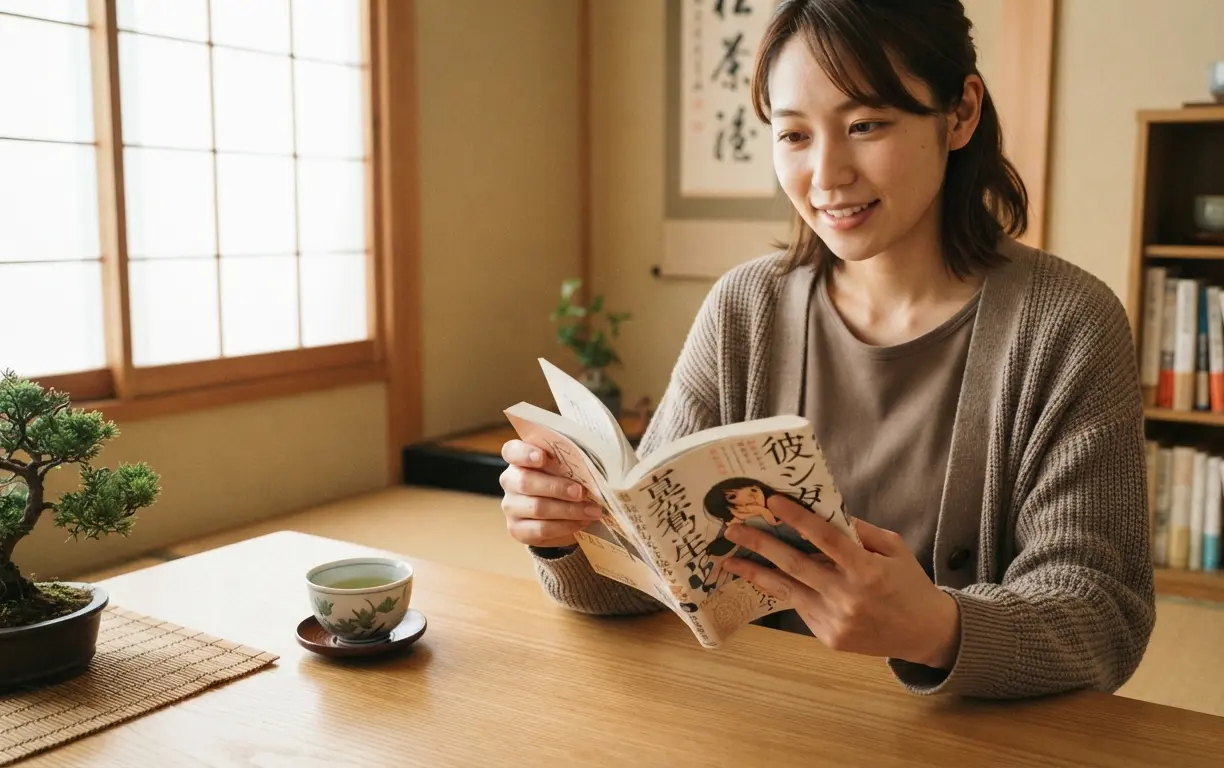
If you pick up a traditional Japanese novel or manga for the first time, your first instinct is usually to flip to what looks like the back cover.
To someone used to reading English or Hindi, Japanese books appear completely backwards. The front cover sits where the back cover normally is, the spine is on the right, and the pages turn from left to right.
This layout is not a design quirk or printing error. It reflects a traditional writing system with centuries of cultural history.
Understanding how to read Japanese books helps you appreciate how the Japanese writing system works, whether you are browsing manga or preparing to study the language seriously.
Why Japanese Books Open from the Right Side
English books open from the left because English sentences are read horizontally from left to right. When your eyes finish reading a page, turning the page to the left reveals the next lines on the right.
Traditional Japanese text works in the opposite direction.
Because traditional Japanese writing flows vertically from top to bottom, columns are arranged from right to left. A reader starts at the top-right corner of the page, reads downwards to the bottom, and then moves to the next column on the left.
When you reach the bottom-left corner of the page, the story continues onto the next page to the left.
As a result, the spine of the book must be bound on the right side. What looks like the "back" to an English reader is actually the starting point for Japanese readers.
Understanding Tategaki and Yokogaki: Vertical vs. Horizontal Writing
Modern Japanese is unique because it uses two distinct writing directions depending on the medium and context.
|
Feature |
Tategaki (縦書き) |
Yokogaki (横書き) |
|---|---|---|
|
Meaning |
Vertical writing |
Horizontal writing |
|
Reading Order |
Top to bottom, columns move right to left |
Left to right, rows move top to bottom |
|
Page Turning |
Left to right (spine on the right) |
Right to left (spine on the left) |
|
Common Uses |
Novels, newspapers, literary magazines, manga |
Websites, textbooks, science papers, computer screens |
|
Historical Origin |
Traditional classical Japanese and Chinese script |
Adopted during modernization and Western contact |
Tategaki (Vertical Writing)
Tategaki is the traditional Japanese format. Historical calligraphy, classical scrolls, and traditional woodblock prints were all written vertically.
In Tategaki:
- You start reading at the top-right corner.
- Each column runs vertically down to the bottom.
- Once a column ends, your eyes shift to the column immediately to its left.
- Punctuation marks, such as Japanese periods (。) and commas (、), sit in the upper-right corner of their character spaces.
Most Japanese fiction novels, literary essays, daily newspapers, and poetry collections are still printed in Tategaki today.
Yokogaki (Horizontal Writing)
Yokogaki represents horizontal writing, flowing from left to right just like English.
While historical horizontal signs sometimes ran right to left, modern Japanese horizontal writing exclusively follows the standard left-to-right direction.
Yokogaki is standard for:
- Japanese websites, smartphone interfaces, and digital apps
- Academic textbooks involving mathematics, science, or foreign languages
- Business reports and technical manuals
- Subtitles on videos and television broadcasts
Because contemporary readers encounter both formats daily, Japanese speakers switch between vertical and horizontal reading effortlessly.
Why Japanese Manga Is Read from Right to Left
Manga remains one of the most common ways international readers encounter Japanese reading direction.
When Japanese manga is published in Japan, it is created using vertical dialogue text (Tategaki) embedded inside visual speech bubbles. Because the dialogue flows from right to left, the artistic panels must follow the same flow.
The Manga Panel Reading Rule
To read Japanese manga correctly, follow the "Right-to-Left, Top-to-Bottom" principle:
1. Start with the top-right panel: This is always the starting frame on any page.
2. Move horizontally to the left: Read any panels located on the same horizontal row.
3. Move downward: Shift your eyes to the next tier of panels below.
4. Read speech bubbles right to left: Inside each panel, read the dialogue bubble furthest to the right first, then read bubbles to the left.
Years ago, Western publishers used to "flip" or mirror manga images so they would read left to right like American comic books.
However, flipping often distorted the original artwork, made right-handed characters appear left-handed, and inverted background signs. Today, publishers worldwide keep the authentic Japanese right-to-left layout, preserving the creator's artistic vision.
Visual Comparison: English vs. Japanese Reading Direction
Comparing both systems side by side makes the mechanics easy to visualize.
|
Aspect |
Standard English Format |
Traditional Japanese Format (Tategaki) |
|---|---|---|
|
Text Flow |
Left to right across horizontal lines |
Top to bottom down vertical columns |
|
Line / Column Progression |
Downward from top to bottom |
Leftward from right to left |
|
Starting Point on Page |
Top-left corner |
Top-right corner |
|
Book Spine Location |
Left side |
Right side |
|
Page Turning Direction |
Turn pages from right to left |
Turn pages from left to right |
Once you understand this visual logic, a Japanese book no longer feels backwards. It simply follows its own natural, balanced sequence.
Is Japanese Reading Direction Difficult for Beginners?
Adjusting to right-to-left vertical reading feels unusual for the first few days, but the human brain adapts quickly.
Most beginners find that after reading two or three chapters of a manga or a graded reader, the reading path becomes second nature.
Practical tips to build reading comfort:
- Start with Hiragana and Katakana: Master the basic phonetic scripts first so your eyes focus on sound recognition rather than layout confusion.
- Practice with children's books and manga: Graded readers and slice-of-life manga feature short sentences and visual cues that make tracking panels intuitive.
- Track columns with a bookmark: If your eyes skip columns when reading vertical text, place a ruler or card to the left of the column you are reading.
- Read simple horizontal texts first: You do not have to tackle vertical novels right away. Beginner textbook dialogues and online learning materials use horizontal text (Yokogaki).
If you are eager to build your Japanese reading and speaking skills with structured guidance, joining a professional course makes all the difference.
You can Learn Japanese in Delhi with native-level instructors who introduce reading formats step by step, ensuring you master both vertical and horizontal texts naturally.
Learn japanese in delhi provides comprehensive Japanese language classes that guide you from foundational scripts up to advanced JLPT levels.
Wrapping Up
Japanese books are not backwards. They are thoughtfully designed around a vertical writing tradition that dates back over a thousand years.
Tategaki flows top to bottom, moving right to left across the page, which places the spine on the right side. Yokogaki provides a modern, horizontal alternative for digital screens, science, and international communication.
Manga continues this visual tradition, organizing art panels and speech bubbles to match the rhythm of vertical Japanese speech.
With consistent exposure, switching between horizontal English and vertical Japanese becomes second nature. Visit Learn japanese in delhi to start your Japanese learning journey today with guided courses designed for every skill level.
FAQs
Do Japanese people read from right to left?
Yes, when text is written vertically in the traditional Tategaki format, columns are read from right to left.
However, when Japanese text is written horizontally (Yokogaki), such as on websites, smartphones, and in modern scientific books, it is read from left to right, exactly like English.
Is Japanese written vertically or horizontally?
Japanese can be written both vertically and horizontally.
Vertical writing (Tategaki) is standard for novels, literature, newspapers, and printed manga. Horizontal writing (Yokogaki) is standard for computer screens, scientific publications, language textbooks, and everyday digital communication.
Why is Japanese manga read backwards?
Manga is read from right to left because Japanese speech bubbles and panels follow traditional vertical reading order.
Starting at the top-right corner allows readers to absorb dialogue and visual action in the natural sequence intended by the original manga artist.
Is Japanese reading difficult for beginners?
Adjusting to the layout takes a little practice, but most learners become comfortable within a few days.
Beginners usually start with horizontal textbooks before moving on to vertical readers. Focusing on mastering Hiragana and Katakana first helps make reading feel natural, regardless of the text direction.