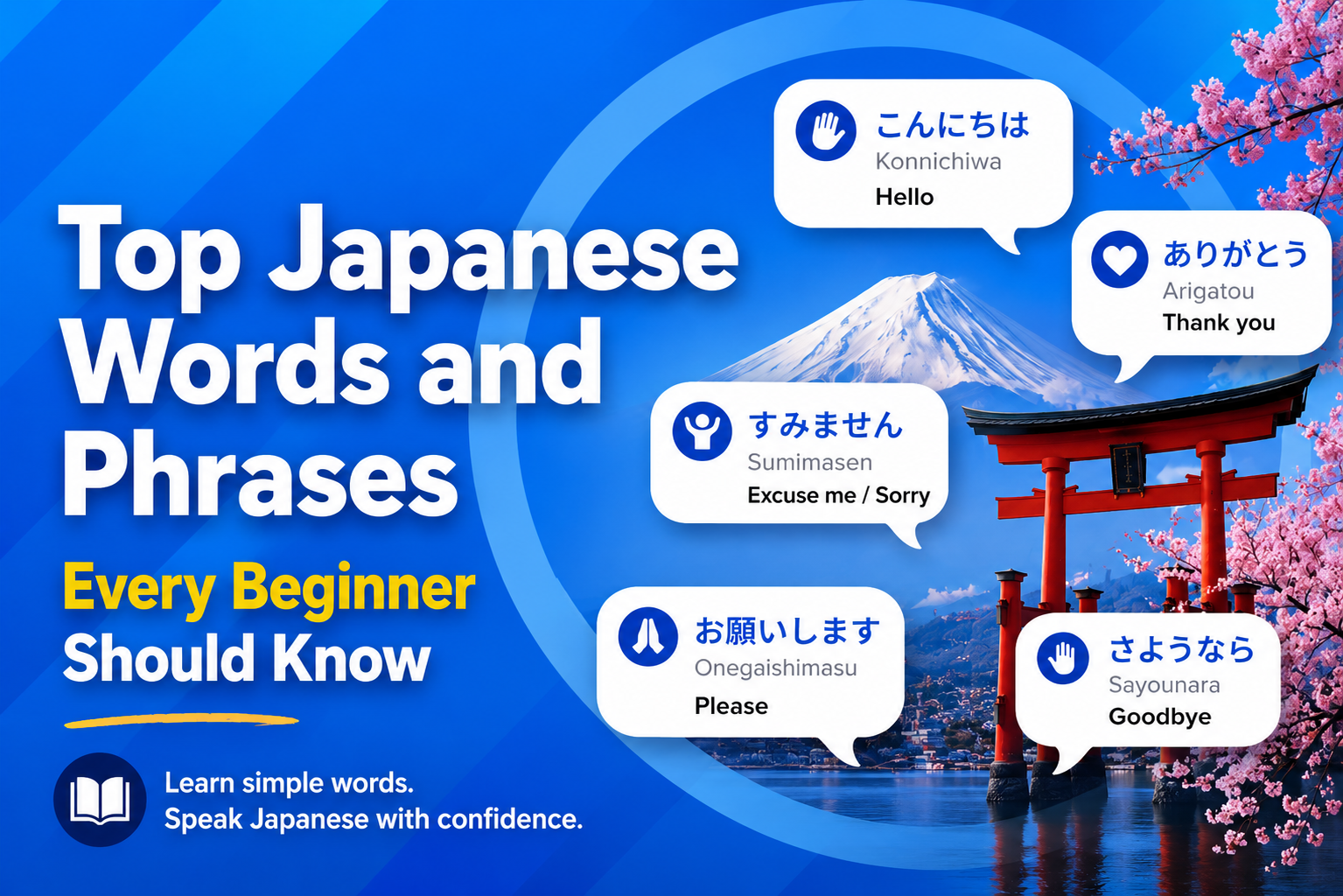
Most people start learning Japanese and immediately wonder where to begin. The answer is simpler than it looks: start with the words you will actually use. Everyday vocabulary builds confidence faster than grammar rules or textbooks alone. When you can say hello, thank you, and excuse me in Japanese, you start to feel the language is within reach.
This guide covers the top Japanese words and phrases every beginner should know, with pronunciation, meaning, and practical context.
Why Start With Everyday Japanese Words?
Learning basic Japanese words does two things at once.
First, it gives you real language you can use from day one. Even a few phrases help you connect with Japanese speakers and navigate everyday situations.
Second, it trains your ear and mouth to get comfortable with Japanese sounds. This makes everything else, including grammar and kanji, easier to absorb later.
According to the Japan Foundation's Japanese Language Survey, Japanese is studied by millions of learners worldwide. Most successful beginners start with high-frequency words and build outward from there.
The words in this guide are among the most commonly used in daily life, travel, and conversation. Learn these well, and you will have a strong foundation to build on.
Basic Japanese Greetings You Will Use Every Day
Greetings are the first thing anyone says in Japanese. Learning these correctly makes a strong first impression.
|
Japanese |
Romaji |
Meaning |
|
おはようございます |
Ohayou Gozaimasu |
Good Morning (formal) |
|
おはよう |
Ohayou |
Good Morning (casual) |
|
こんにちは |
Konnichiwa |
Hello / Good Afternoon |
|
こんばんは |
Konbanwa |
Good Evening |
|
さようなら |
Sayounara |
Goodbye (formal) |
|
またね |
Mata ne |
See you later (casual) |
|
はじめまして |
Hajimemashite |
Nice to Meet You |
|
お元気ですか |
Ogenki desu ka |
How are you? |
|
元気です |
Genki desu |
I am fine |
Quick tip: In Japan, context matters. Use the formal versions (おはようございます, さようなら) in professional settings or when speaking to someone older or senior to you.
Polite Expressions That Make a Real Difference
Japanese culture places high value on politeness. These expressions are used constantly in daily life.
|
Japanese |
Romaji |
Meaning |
|
ありがとうございます |
Arigatou Gozaimasu |
Thank You (formal) |
|
ありがとう |
Arigatou |
Thank You (casual) |
|
どういたしまして |
Dou Itashimashite |
You're Welcome |
|
すみません |
Sumimasen |
Excuse Me / Sorry |
|
ごめんなさい |
Gomen Nasai |
I'm Sorry |
|
お願いします |
Onegaishimasu |
Please |
|
はい |
Hai |
Yes |
|
いいえ |
Iie |
No |
Sumimasen is one of the most versatile words in Japanese. You can use it to get someone's attention, apologise mildly, or ask for a favour. Beginners use it constantly, and it is always appropriate.
Common Everyday Japanese Words
These are high-frequency words that appear in daily conversations, shopping, school, and work.
|
Japanese |
Romaji |
Meaning |
|
水 |
Mizu |
Water |
|
食べ物 |
Tabemono |
Food |
|
友達 |
Tomodachi |
Friend |
|
学校 |
Gakkou |
School |
|
家 |
Uchi / Ie |
Home / House |
|
お金 |
Okane |
Money |
|
時間 |
Jikan |
Time |
|
仕事 |
Shigoto |
Work / Job |
|
電車 |
Densha |
Train |
|
今日 |
Kyou |
Today |
|
明日 |
Ashita |
Tomorrow |
|
大丈夫 |
Daijoubu |
It's okay / Are you alright? |
Daijoubu is another incredibly useful word. You will hear it in anime constantly. In real life, it is used to check on someone, confirm something is fine, or reassure a person.
Helpful Japanese Phrases for Travelers
If you are visiting Japan or preparing for a trip, these phrases will help you get around comfortably.
|
Japanese |
Romaji |
Meaning |
|
駅はどこですか? |
Eki wa doko desu ka? |
Where is the station? |
|
これはいくらですか? |
Kore wa ikura desu ka? |
How much is this? |
|
わかりません |
Wakarimasen |
I don't understand |
|
英語を話せますか? |
Eigo o hanasemasu ka? |
Do you speak English? |
|
助けてください |
Tasukete kudasai |
Please help me |
|
トイレはどこですか? |
Toire wa doko desu ka? |
Where is the toilet? |
|
右 / 左 |
Migi / Hidari |
Right / Left |
|
まっすぐ |
Massugu |
Straight ahead |
Even knowing three or four of these phrases can make a trip to Japan significantly more comfortable.
Numbers in Japanese From 1 to 10
Numbers are essential from the very beginning. You will use them for prices, floors, times, and quantities.
|
Number |
Japanese |
Romaji |
|
1 |
一 |
Ichi |
|
2 |
二 |
Ni |
|
3 |
三 |
San |
|
4 |
四 |
Shi / Yon |
|
5 |
五 |
Go |
|
6 |
六 |
Roku |
|
7 |
七 |
Nana / Shichi |
|
8 |
八 |
Hachi |
|
9 |
九 |
Ku / Kyuu |
|
10 |
十 |
Juu |
Pronunciation note: Each vowel in Japanese is pronounced clearly and consistently. "A" sounds like "ah", "I" like "ee", "U" like "oo", "E" like "eh", and "O" like "oh". This makes Japanese pronunciation one of the more learnable aspects for beginners.
Everyday Question Words in Japanese
These six question words are the building blocks of conversation.
|
Japanese |
Romaji |
Meaning |
|
何 |
Nani |
What |
|
どこ |
Doko |
Where |
|
誰 |
Dare |
Who |
|
なぜ / どうして |
Naze / Doushite |
Why |
|
いつ |
Itsu |
When |
|
どう / どのように |
Dou / Dono you ni |
How |
Once you know these words and pair them with basic vocabulary, you can form simple questions almost immediately.
For example: "Kore wa nani desu ka?" (これは何ですか?) simply means "What is this?" It is one of the first questions most beginners ask and one of the most useful in real conversations.
How to Remember Japanese Vocabulary Without Forgetting It
Learning words is one thing. Retaining them is another.
Here are five practical techniques that work for beginners:
● Practice daily: Even 10 to 15 minutes a day is enough to reinforce new vocabulary. Consistency beats long occasional sessions.
● Use flashcards: Apps like Anki use spaced repetition, showing you words at the right time intervals to lock them into long-term memory.
● Watch Japanese content with subtitles: Anime, dramas, and YouTube channels help you hear words in real context. Switch to Japanese subtitles as your reading improves.
● Say the words aloud: Speaking activates a different part of memory than reading. Pronouncing words out loud helps you remember them faster.
● Revise weekly: Set aside time each week to review older vocabulary. This prevents words from fading before they become automatic.
Joining a structured beginner Japanese course gives you a vocabulary schedule built into your learning, so you do not have to decide what to study each day. Explore the Japanese language courses at NihongoMax to find a beginner batch that suits your schedule.
Quick Reference Table: Japanese Words With Pronunciation
|
Category |
Japanese |
Romaji |
English Meaning |
|
Greeting |
おはようございます |
Ohayou Gozaimasu |
Good Morning |
|
Greeting |
こんにちは |
Konnichiwa |
Hello |
|
Greeting |
さようなら |
Sayounara |
Goodbye |
|
Polite |
ありがとうございます |
Arigatou Gozaimasu |
Thank You |
|
Polite |
すみません |
Sumimasen |
Excuse Me |
|
Polite |
お願いします |
Onegaishimasu |
Please |
|
Everyday |
水 |
Mizu |
Water |
|
Everyday |
友達 |
Tomodachi |
Friend |
|
Everyday |
大丈夫 |
Daijoubu |
It's okay |
|
Travel |
わかりません |
Wakarimasen |
I don't understand |
|
Travel |
駅はどこですか? |
Eki wa doko desu ka? |
Where is the station? |
|
Number |
一, 二, 三 |
Ichi, Ni, San |
1, 2, 3 |
|
Question |
どこ |
Doko |
Where |
|
Question |
何 |
Nani |
What |
|
Question |
いつ |
Itsu |
When |
Print this table, save it on your phone, or copy it into your vocabulary notebook. Review it once a day for the first two weeks, and most of these words will become automatic.
Wrapping Up
Mastering basic Japanese words and phrases is the fastest way to feel confident when starting out.
You do not need to memorise thousands of words to hold a simple conversation or travel comfortably in Japan. The words in this guide cover greetings, daily needs, travel, numbers, and questions: the building blocks of real communication.
Start small, practice daily, and build your vocabulary one layer at a time.
When you are ready to go deeper and work toward JLPT preparation, structured grammar learning, and speaking fluency, a qualified Japanese language course makes the journey faster and more effective. Visit NihongoMax to explore course options for all levels, from complete beginners to advanced learners.
FAQs
What are the first Japanese words beginners should learn?
Start with greetings (Konnichiwa, Ohayou), polite expressions (Arigatou, Sumimasen), basic yes and no (Hai, Iie), and numbers 1 to 10. These words appear in almost every conversation and give you a practical foundation to build on quickly.
Is Japanese difficult for beginners?
Japanese has a reputation for being challenging, mainly because of its three writing systems and grammar structure.
However, pronunciation is consistent and logical, which makes it more accessible than many expect. Most beginners make noticeable progress within the first few weeks when following a structured course.
How many Japanese words should I learn every day?
For most beginners, 5 to 10 new words per day is a sustainable and effective pace.
The key is daily review, not just learning new words. Revisiting words from previous days through flashcards or speaking practice is what moves them into long-term memory.
Can I learn basic Japanese in one month?
Yes, in one month of consistent daily practice you can:
● Learn Hiragana and Katakana (the two basic scripts)
● Master common greetings and polite expressions
● Build a vocabulary of 150 to 200 essential words
● Form simple sentences in Japanese
One month will not make you fluent, but it will give you a solid and usable foundation.