
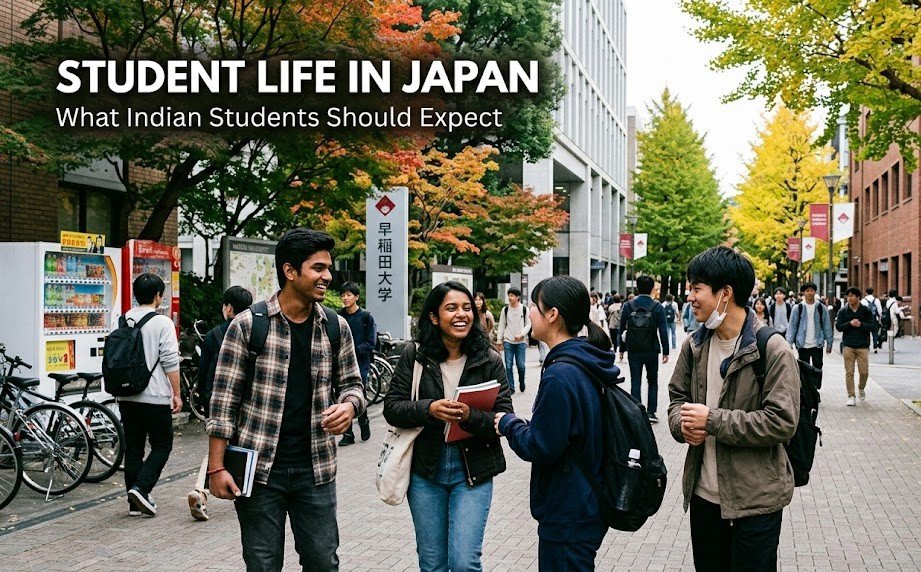
Japan is attracting more Indian students than ever before. World-class universities, strong scholarship programs, advanced technology, and a safe environment make Japan one of the most appealing study destinations in Asia.
But moving to a new country is a significant step. Understanding what to expect before you arrive makes the transition far smoother.
This guide covers everything Indian students in Japan need to know: accommodation, costs, academic culture, daily life, common challenges, and practical tips to help you settle in confidently.
Why Japan Is Becoming a Top Study Destination for Indian Students
Japan offers a combination of academic quality and practical opportunity that few countries can match.
Here is what makes Japan stand out for Indian students:
● World-class universities: Japan is home to globally ranked institutions including the University of Tokyo, Kyoto University, and Osaka University, with strong programs in engineering, technology, medicine, and business.
● Scholarship opportunities: The Japanese Government MEXT Scholarship covers tuition, accommodation, and a monthly stipend for eligible international students. Many universities also offer their own merit-based scholarships.
● Safe and clean environment: Japan consistently ranks among the safest countries in the world. Public spaces are clean, public transport is reliable, and crime rates are extremely low.
● Advanced technology and research: For students in engineering, robotics, AI, and science, Japan's research infrastructure is among the best in the world.
● Career prospects: Japanese companies actively recruit internationally trained graduates. A degree from a Japanese university, combined with Japanese language skills, opens strong career opportunities both in Japan and in India.
● Global exposure: Living and studying in Japan builds cross-cultural competence and a global perspective that employers value highly.
Study in Japan for Indian students has grown significantly in recent years, and the trend is expected to continue as India-Japan education partnerships strengthen.
Student Accommodation Options in Japan
Finding the right place to live is one of the first tasks after getting admission.
University Dormitories
Most universities offer dormitories for international students, particularly in the first year.
● Cost: Approximately 15,000 to 40,000 yen per month (roughly INR 8,000 to 21,000), depending on the university and facilities.
● Pros: Affordable, safe, close to campus, easier to make friends, utilities sometimes included.
● Cons: Limited space, shared facilities, strict rules in some dorms, availability is not guaranteed.
Apply for dormitories as early as possible. Spots are limited and often allocated on a first-come basis.
Shared Apartments
Sharing an apartment with other students is a popular and practical choice.
● Cost: Approximately 25,000 to 50,000 yen per month per person, depending on the city and location.
● Pros: More independence, larger space, flexible living arrangements.
● Cons: Requires a guarantor, lease agreements can be complex, coordination with housemates needed.
Many universities have student support offices that help international students find shared housing.
Private Rentals
Private apartments give you full independence but come at a higher cost.
● Cost: Approximately 50,000 to 90,000 yen per month for a small studio or one-room apartment in major cities like Tokyo or Osaka.
● Pros: Complete privacy and flexibility.
● Cons: Higher rent, utility bills, and initial deposit (usually two to three months' rent upfront).
Cities like Sapporo, Sendai, and Fukuoka offer more affordable private rental options than Tokyo.
Homestays
Living with a Japanese family is a less common but genuinely enriching option.
● Cost: Approximately 60,000 to 80,000 yen per month, usually including meals.
● Pros: Deep cultural immersion, home-cooked meals, built-in support network.
● Cons: Less independence, possible location distance from campus.
Tip for finding affordable housing: Use university housing boards, connect with Indian student communities on social media before arriving, and ask seniors already studying in Japan for recommendations.
How Much Does It Cost to Live in Japan as a Student?
Japan is not a cheap country, but student life in Japan is manageable with good planning.
Here is an approximate monthly budget breakdown for a student in Japan:
|
Expense |
Estimated Monthly Cost (Yen) |
Approximate INR |
|
Accommodation |
20,000 to 50,000 |
10,500 to 26,500 |
|
Food and groceries |
20,000 to 30,000 |
10,500 to 16,000 |
|
Transportation |
5,000 to 10,000 |
2,600 to 5,300 |
|
Utilities |
5,000 to 10,000 |
2,600 to 5,300 |
|
Mobile and internet |
2,000 to 5,000 |
1,000 to 2,600 |
|
Health insurance |
1,500 to 2,000 |
800 to 1,000 |
|
Entertainment and personal |
5,000 to 15,000 |
2,600 to 8,000 |
|
Total (approx.) |
58,500 to 1,22,000 |
30,000 to 64,000 |
Note: These are general estimates. Actual costs vary by city, lifestyle, and university. Tokyo and Osaka are more expensive than smaller cities.
Students in Japan on a student visa are permitted to work part-time for up to 28 hours per week, which many Indian students use to offset living costs.
What Academic Life in Japan Is Really Like
Japanese universities have a distinct academic culture that is worth understanding before you arrive.
Classroom culture:
● Lectures are often formal. Students are expected to listen, take notes, and ask questions respectfully.
● Group work and presentations are common, especially in graduate programs.
● Participation and punctuality are taken seriously. Arriving late to a class or meeting is considered disrespectful.
Attendance:
● Most universities have strict attendance policies. Missing a set number of classes can affect your grade or eligibility to sit for exams.
Assignments and exams:
● Academic workload is significant. Deadlines are expected to be met without exception.
● Research-oriented programs at Japanese universities are rigorous, particularly in science and engineering fields.
Interaction with professors:
● Japanese academic culture tends to be formal. Address professors respectfully and use appropriate titles.
● Building a good relationship with your professor or supervisor is important, especially for research students.
Research opportunities:
● Japan offers excellent research facilities. Students in STEM fields can access labs and equipment that are among the best in the world.
Daily Life and Japanese Culture for International Students
Understanding daily life in Japan helps Indian students adapt more quickly.
Public transport:
● Japan's train and bus network is one of the most efficient in the world. Trains run on time, almost without exception.
● Get an IC card (like Suica or Pasmo) at the station to pay for trains, buses, and even convenience store purchases.
Cleanliness and waste segregation:
● Japan has strict rules about how waste is sorted and disposed of. Different types of rubbish have different collection days.
● Public spaces are kept very clean. Littering is socially unacceptable.
Convenience stores:
● Convenience stores (7-Eleven, FamilyMart, Lawson) are a daily fixture of life in Japan. They sell affordable meals, snacks, stationery, ATM access, and even pay utility bills.
● They are open 24 hours and are genuinely useful for students.
Food options:
● Indian students will find Japanese cuisine varied and affordable. Rice, noodles, tofu, and vegetables are staples.
● Vegetarian options are available but require effort to find in some areas. Convenience stores and supermarkets stock vegetarian-friendly products.
● Indian grocery stores and restaurants exist in larger cities like Tokyo, Osaka, and Nagoya.
Festivals and local traditions:
● Japan has a rich calendar of festivals throughout the year. Participating in local events is one of the best ways to experience Japanese culture.
Social etiquette:
● Bowing is the standard greeting. A slight nod is enough in casual situations.
● Speak quietly in public spaces, especially on trains.
● Remove shoes when entering homes and some traditional spaces.
Challenges Indian Students Often Face in Japan
Being prepared for these challenges makes a big difference.
● Language barrier: Japanese is not widely spoken in English outside of tourist areas and some university campuses. Learning basic Japanese before arriving is strongly recommended and will make daily life significantly easier.
● Homesickness: Japan is far from India, and the cultural differences can feel isolating at first. Staying connected with family and joining Indian student communities helps.
● Cultural differences: Japanese social norms are quite different from Indian ones. Indirect communication, reserved behaviour, and strict rule-following can take time to get used to.
● Weather adaptation: Japan has four distinct seasons. Winters can be very cold, especially in cities like Sapporo and Sendai. Summers are hot and humid. Pack accordingly and prepare for seasonal changes.
● Budget management: Managing finances in a country with a different currency and cost structure takes adjustment. Track expenses weekly until you find a routine that works.
Practical Tips for a Smooth Student Life in Japan
These steps will help you settle in faster and feel more confident:
● Learn basic Japanese before arriving: Even conversational N5 or N4 level Japanese makes daily tasks, like grocery shopping, commuting, and interacting with neighbours, significantly easier.
● Open a bank account early: You will need a Japanese bank account for your salary if you work part-time, and for automatic bill payments.
● Get a transport IC card: Buy a Suica or Pasmo card at any major train station as soon as you arrive.
● Join student clubs and circles: Japanese universities have a wide range of clubs. Joining one is one of the fastest ways to make Japanese friends and build a social network.
● Build a local network: Connect with other international students as well as Japanese classmates. Your network will help you with housing tips, part-time work leads, and cultural guidance.
● Manage expenses wisely: Cook at home where possible, use supermarket discounts in the evening, and use your IC card for transport instead of taxis.
● Respect Japanese customs: Being mindful of local norms, punctuality, cleanliness, and respectful communication, helps you integrate more smoothly and leave a positive impression.
One of the best things you can do before moving to Japan is to start learning the language. Even a beginner foundation in Japanese reduces the learning curve significantly and helps you feel more at home from day one. Explore the Japanese language courses at NihongoMax and find a batch that fits your schedule before you travel.
Wrapping Up
Student life in Japan for Indian students is rich, rewarding, and sometimes challenging. Japan offers academic excellence, a safe environment, a unique culture, and career opportunities that are hard to find elsewhere. With the right preparation, including understanding costs, finding good accommodation, and learning Japanese basics, the transition becomes much smoother. The students who thrive in Japan are the ones who prepare early, stay curious, and embrace the experience fully. If you are planning to study in Japan, start your Japanese language preparation now. Visit NihongoMax to explore beginner-friendly courses and JLPT preparation programs designed for Indian learners.
FAQs
How much does student life in Japan cost?
Monthly living costs for a student in Japan typically range from approximately 60,000 to 1,20,000 yen (around INR 31,000 to 63,000), depending on the city, accommodation type, and lifestyle. Costs are higher in Tokyo and Osaka and lower in smaller cities. Scholarship recipients and part-time workers can manage expenses more comfortably.
Can Indian students work while studying in Japan?
Yes. Students on a Japanese student visa are permitted to work part-time for up to 28 hours per week. Many Indian students work at convenience stores, restaurants, or tutoring centres to help cover living costs. A work permit (resource activity permission) needs to be obtained from the immigration office, which your university can help with.
Is Japanese language necessary to study in Japan?
It depends on your program. Many graduate and research programs, particularly in STEM, are offered in English. However, daily life, part-time work, and social integration become significantly easier with at least basic Japanese skills. For undergraduate programs and most non-English courses, Japanese language proficiency (often JLPT N2 or above) is required for admission.
What challenges do Indian students face in Japan?
The most common challenges include:
● Language barrier in daily life outside campus
● Adjusting to Japanese cultural norms and communication style
● Managing a higher cost of living compared to India
● Homesickness and social isolation in the initial months
● Adapting to Japan's seasonal weather, especially cold winters
Preparation before arrival, including learning Japanese and connecting with the Indian student community, reduces most of these challenges significantly.
Is Japan safe for international students?
Yes. Japan is consistently ranked among the safest countries in the world for international residents and students. Crime rates are very low. Public spaces are clean and well-maintained. Emergency services are reliable. Indian students generally report feeling very safe in Japan, even in large cities like Tokyo and Osaka.