
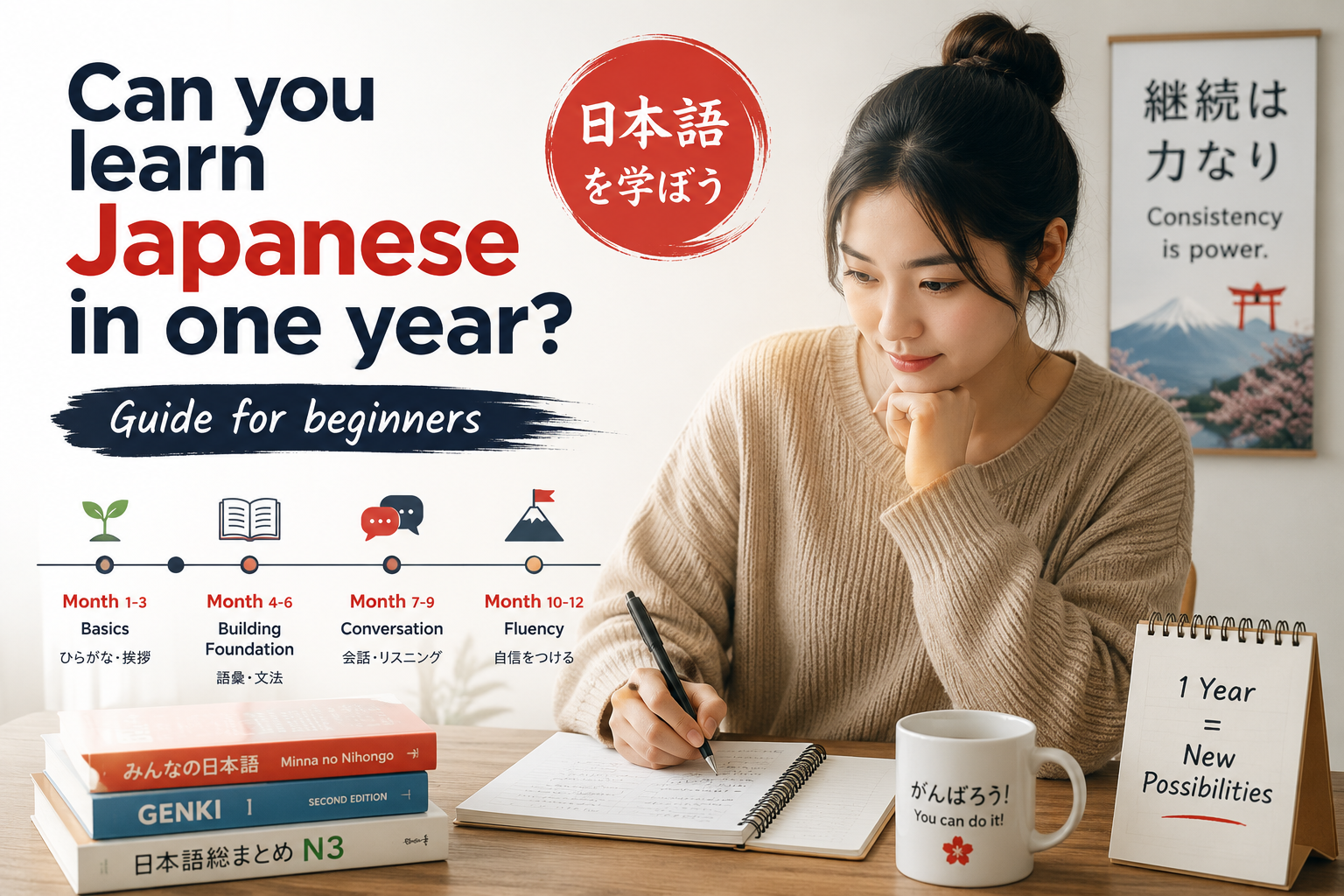
One year sounds like a long time. But when it comes to learning Japanese, many beginners are not sure whether it is enough. Can you actually go from zero to conversational Japanese in 12 months? What JLPT level can you realistically reach? And how much do you need to study each day?
This guide answers all of that, with a practical roadmap to help you make the most of your first year.
Is It Realistic to Learn Japanese in One Year?
What Does "Learning Japanese" Actually Mean?
This question matters more than most people realise.
"Learning Japanese" can mean different things depending on your goal:
● Holding a basic conversation
● Reading simple texts in Hiragana and Katakana
● Passing JLPT N5 or N4
● Reaching working-level proficiency for a job
One year is realistic for several of these goals. It is not realistic for all of them at once.
Setting Realistic Expectations
Japanese is one of the more challenging languages for English speakers. It has three writing systems, a different grammar structure, and levels of formality that require practice to use correctly.
That said, one year of consistent study can take you from a complete beginner to a confident elementary or intermediate learner. Progress is very possible with the right approach.
Factors That Shape Your Progress
How fast can you learn Japanese? The honest answer depends on:
● Hours studied per day: More consistent daily practice means faster progress.
● Quality of instruction: A structured beginner Japanese course moves you faster than self-study alone.
● Prior language experience: Those who have studied other Asian languages may find patterns easier to recognise.
● Consistency: Studying every day, even for 30 minutes, beats long sessions done occasionally.
What Japanese Level Can You Reach in 12 Months?
Reaching JLPT N5 and N4
With regular study and a structured course, most beginners can reach JLPT N5 in 3 to 4 months and JLPT N4 in 6 to 8 months.
These two levels cover:
● Basic Hiragana and Katakana
● Around 800 vocabulary words
● Fundamental grammar patterns
● Simple reading and listening comprehension
JLPT N5 and N4 together form a solid foundation for daily communication and further study.
Can You Achieve JLPT N3 in One Year?
JLPT N3 is achievable in one year, but it requires dedicated effort.
N3 covers approximately 650 kanji and 3,750 vocabulary words. You will need to study 1 to 2 hours daily, use a structured Japanese study plan, and practice speaking regularly. Learners who join a JLPT-focused course and maintain daily Japanese practice have successfully cleared N3 within 10 to 12 months.
Is Fluency Possible in 12 Months?
Full fluency, meaning the ability to discuss complex topics naturally in Japanese, typically takes several years of dedicated study.
However, you can achieve conversational fluency at a basic to intermediate level in one year. You will be able to introduce yourself, handle everyday situations, and hold simple conversations with Japanese speakers.
That is a meaningful and genuinely useful level of Japanese to reach in 12 months.
How Much Should You Study Each Day?
Studying 30 Minutes a Day
If you can spare only 30 minutes daily, focus on:
● Vocabulary review using flashcard apps
● One grammar point per session
● Listening to short Japanese audio clips
At this pace, reaching JLPT N5 in 4 to 6 months is realistic with a structured course supporting your self-study.
Studying 1 to 2 Hours a Day
This is the recommended pace for most learners. With 1 to 2 hours of daily Japanese practice, you can:
● Cover grammar and vocabulary systematically
● Practice reading and writing alongside speaking
● Reach JLPT N4 in 6 months and attempt N3 by month 12
Intensive Learning Plans
Some learners, particularly those preparing for work or study in Japan, choose to study 3 or more hours a day.
This accelerated approach, especially when combined with a beginner Japanese course led by qualified trainers, can push you to JLPT N3 or even N2 preparation within a year.
Your One-Year Japanese Learning Roadmap
Months 1 to 3: Master Hiragana and Katakana
Start here, without skipping ahead.
Hiragana and Katakana are the two phonetic scripts used in everyday Japanese. Learning both takes 2 to 4 weeks with regular practice.
By the end of month 3, you should also have:
● A working vocabulary of 300 to 500 basic words
● Familiarity with greetings and simple sentence patterns
● The ability to introduce yourself in Japanese
Months 4 to 6: Build Vocabulary and Grammar
This is where your foundation becomes a structure.
Focus on:
● N5-level grammar patterns (particles, verb conjugation, basic sentence structure)
● Expanding vocabulary to 700 to 800 words
● Simple reading practice using Hiragana texts
● Attempting your first JLPT N5 mock test by month 6
Months 7 to 9: Strengthen Reading and Listening
At this stage, start exposing yourself to more Japanese content.
● Begin learning basic Kanji (aim for 100 to 150 characters)
● Practice listening with short podcasts or simple Japanese videos
● Read beginner-level Japanese texts and short stories
● Work on JLPT N4 grammar and vocabulary
Months 10 to 12: Prepare for JLPT and Practice Speaking
The final phase is about consolidating and testing what you know.
● Take JLPT N4 or N3 mock tests regularly
● Identify and review weak areas
● Practice speaking with a language partner or tutor
● Focus on listening comprehension under exam conditions
By month 12, a dedicated learner following this Japanese study plan can sit for JLPT N4 with confidence and be on track for N3.
Practical Tips to Learn Japanese Faster
Practice Every Day
Consistency matters more than the length of each session.
Twenty minutes every day builds stronger memory retention than a two-hour session once a week. Make daily Japanese practice a non-negotiable habit.
Watch Japanese Content
Anime, Japanese dramas, and YouTube channels expose you to natural speech patterns and vocabulary in context.
Watch with Japanese subtitles where possible. Pause, repeat, and note down new words.
Speak With Native Speakers
Speaking is often the most neglected part of Japanese study.
Use language exchange apps to practise with native speakers. Even short conversations once or twice a week build real confidence and fluency faster than silent study alone.
Join a Structured Course
This is the most effective step you can take.
A structured beginner Japanese course gives you a clear path, qualified guidance, regular feedback, and a schedule that keeps you accountable. Self-study works best when it supports a structured program, not the other way around.
Common Mistakes That Slow Down Your Progress
Trying to Learn Everything at Once
Many beginners try to study Hiragana, Katakana, Kanji, grammar, and vocabulary all at the same time.
This leads to confusion and burnout. Follow a step-by-step Japanese study plan. Master each stage before moving to the next.
Skipping Speaking Practice
Reading and writing alone will not make you fluent.
Speaking Japanese regularly, even at a basic level, trains your brain to process and produce the language naturally. Do not wait until you feel "ready." Start speaking early.
Inconsistent Study Habits
Taking long breaks or studying only when motivated will significantly slow your progress.
Language learning requires regular reinforcement. Even on busy days, review vocabulary for 10 minutes. Small and consistent actions compound over 12 months.
If you are serious about learning Japanese in one year, joining a structured course with a clear JLPT roadmap is the most reliable way to get there. Explore the Japanese language courses at NihongoMax and find a batch that fits your schedule.
Why Learn Japanese With NihongoMax?
JLPT-Focused Curriculum
NihongoMax offers structured courses from N5 to N1, with a clear progression at each level.
Every batch is built around JLPT preparation, so your learning always has a measurable goal.
Experienced Trainers
Courses are led by qualified Japanese language trainers with practical teaching experience.
You get accurate guidance on grammar, pronunciation, and exam strategy from the very beginning.
Interactive Learning Approach
Sessions at NihongoMax include speaking practice, listening exercises, and regular assessments, not just passive instruction.
This active approach helps learners retain vocabulary and grammar more effectively.
Online and Offline Classes
Whether you prefer learning from home or attending in person, NihongoMax offers both formats.
Flexible batch timings make it possible for working professionals and students to learn without disrupting their existing schedule.
Visit NihongoMax to explore course options, batch schedules, and details for your level.
Wrapping Up
Learning Japanese in one year is a realistic goal for beginners who study consistently and follow a structured plan.
You can reach JLPT N4 comfortably and work toward N3 with dedicated daily effort. Full fluency takes longer, but meaningful progress is absolutely possible in 12 months.
Start with Hiragana and Katakana, follow a clear roadmap, and get guidance from qualified trainers. One year from now, you will be glad you started today.
FAQs
How many hours a day should I study Japanese?
For most beginners, 1 to 2 hours of focused daily study is ideal.
This pace allows you to cover grammar, vocabulary, and practice regularly without burnout. Even 30 minutes a day with a structured course is enough to make steady progress toward JLPT N5 and N4.
Is Japanese difficult for beginners?
Japanese has a reputation for being challenging, and it does require learning a new writing system and grammar structure.
However, pronunciation is consistent and logical, which makes it easier than many expect. With the right beginner Japanese course and daily practice, most learners make noticeable progress within the first few weeks.
Can I pass JLPT N3 in one year?
Yes, it is achievable for learners who study 1 to 2 hours daily and follow a structured JLPT preparation course.
JLPT N3 requires around 3,750 vocabulary words and 650 kanji. With consistent study and regular mock tests, passing N3 within 10 to 12 months is a realistic target.
What is the fastest way to learn Japanese?
The fastest approach combines daily practice with structured learning and speaking practice.
Joining a beginner Japanese course, practicing with native speakers, and following a clear Japanese study plan all contribute to faster progress. Consistency is the single most important factor.
Can I learn Japanese online in one year?
Yes, online Japanese classes are a highly effective option, especially for working professionals and learners outside major cities.
Look for a structured online program with live sessions, regular assessments, and a clear JLPT-level curriculum. Many learners successfully reach JLPT N4 or N3 within a year through online study with qualified trainers.